
In November 2024, Oman launched its first AI-powered satellite, Oman Lens-1 (OL-1), in partnership with STAR.VISION Aerospace Group, the first Chinese private aerospace firm to deliver a complete satellite and ground system to a foreign state (Foreign Ministry of Oman 2024). Equipped with onboard AI processing, OL-1 classifies targets, detects environmental change, and compresses data in orbit. It has already demonstrated real-time recognition of ships and aircraft. Framed by its developers as part of a "Space Silk Road," OL-1 is often presented, in both state and corporate narratives, as a story south-south partnership (China News Service 2024).
To function, however, OL-1 depends on an extensive terrestrial infrastructure, including but not limited to energy grids powering data centres and telecommunications networks transmitting its data (Oman Lens 2026). The satellite is the visible tip of a much larger infrastructural stack that has been developed through different avenues, including Chinese ones (AI in Oman 2026). OL-1 is equally the product of Oman’s deliberate strategy to position itself as a mediating node, both politically and infrastructurally, where, as recent developments make clear, each dimension enables and reinforces the other (Foreign Ministry of Oman 2026).
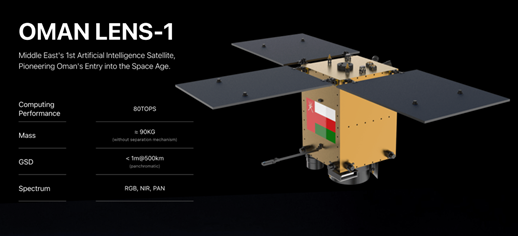
From OMAN LENS-1 website
OL-1 as a project aligns closely with Oman’s broader approach to AI industrial policy.[1] Oman's proposed National AI Supercomputer Centre, developed in collaboration with UNESCO, is designed as a high-performance computing facility for large-scale model training and data-intensive simulations. Its goal is to consolidate fragmented data systems into a sovereign computing ecosystem, thus reducing reliance on foreign cloud providers and lowering barriers to domestic AI development (Oman Observer 2026). At the same time, and interestingly, in January 2026, the Mohammed Al Barwani Group announced a $200 million investment in partnership with U.S.-based Astranis to develop Oman’s first dedicated MicroGEO communications satellite (Astranis 2026). Together, these developments show that Oman is expanding its digital infrastructure through multiple, overlapping channels.
Oman’s geographic position on global subsea cable routes gives it real leverage, where by becoming a processing node for regional data flows, Oman is attempting to monetize that position in the digital economy, much as it has long done with ports and shipping lanes (Equinix). This technological leapfrogging required backing through a finance and investment strategy. Through the Oman Investment Authority, Oman has actively co-developed multiple investment platforms with Chinese partners, including funds targeting advanced manufacturing, clean technology, and digital infrastructure, with combined values in the hundreds of millions of dollars (Zawya 2025). More recently, new investment vehicles, such as a China-linked Central Asia fund, have been designed explicitly to position Oman as a connector across regions, linking Chinese capital, Omani infrastructure, and wider transregional markets (PEI 2025). Chinese state and corporate actors have played a significant role in enabling this trajectory over the past two decades (Ministry of Foreign Affairs, People’s Republic of China 2024), but crucially, these engagements are embedded within Oman’s own long-term effort to translate connectivity into geopolitical and economic centrality (Oman 2040).
This project examines the people, technologies, and politics behind OL-1 by treating it as part of both China and Oman’s AI industrial policy, simultaneously entangled in imperial power structures and mobilized through claims to sovereignty. It builds on earlier work with the AI Now Institute, which began from a simple but consequential reframing: understanding AI as industrial policy, grounded in political and material processes, rather than in cycles of hype (AI Now Institute 2024). Much analysis of AI in the Gulf remains locked in a “new Cold War” frame, casting states as choosing between U.S. and Chinese blocs, this frame is so pervasive that it often structures analysis even when one seeks to move beyond it. This analytical framework assumes a field of winners and losers. What is unfolding, however, is different, as power lies in the capacity to negotiate, maneuver, and act with sovereignty, especially in moments of crisis (Matar & Kadri 2023).
AI is central to this shift. U.S. AI industrial policy tends toward centralization, consolidating control over key infrastructures and standards ( Kak & Myers West 2024), often restricting access through export controls and platform dominance. China’s approach, by contrast, more often disperses capabilities across partnerships and sites, embedding infrastructure through joint projects, technology transfer, and long-term operational integration (Shrivastava 2025). It is this negotiated, distributed terrain, through Oman’s capacity to navigate it, that makes projects like OL-1 possible.
What OL-1 ultimately reveals is that AI industrial policy is a power-shifting practice, one that reorganizes influence through infrastructures binding states into shared systems of dependency. China–Oman relations, in this sense, are defined less by alignment than by the active construction of these interdependencies. To tell the story of OL-1 through the lens of industrial policy, the project is being developed through interviews and sustained conversations with those involved in the satellite’s making, from engineers and policymakers to workers, across both China and Oman, tracing how these infrastructures are imagined, built, and negotiated in practice.
[1] AI industrial policy, as defined by the AI Now Institute, refers to the political-economic strategies through which states and firms build, finance, and govern the infrastructures of artificial intelligence, including compute, data, energy, and logistics, in pursuit of power, security, and influence.